Trading Psychology vs. Algorithmic Discipline
Why the human mind is your biggest market risk — and how structural discipline removes the biases that destroy accounts.
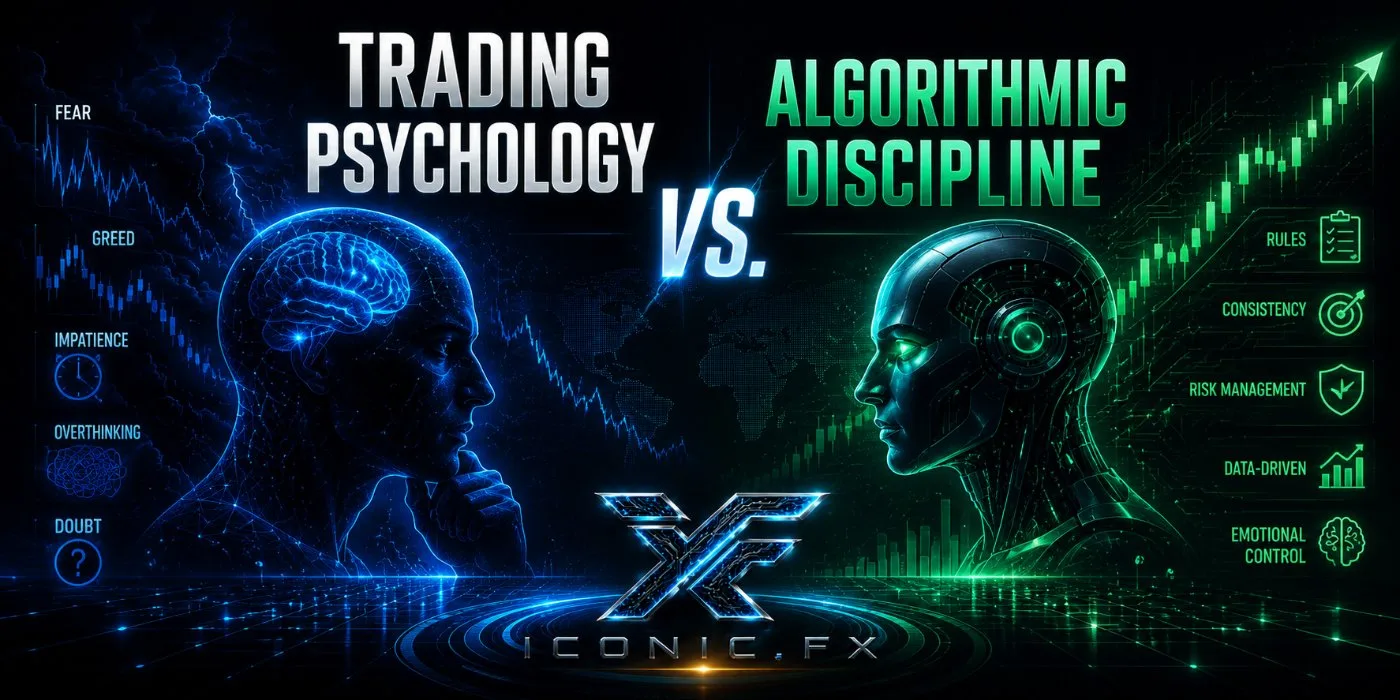
Every serious post-mortem on a blown trading account reaches the same conclusion. The strategy was usually fine. The entry logic worked, at least on paper. What failed was the person executing it — the hesitation on a valid signal, the decision to hold a losing trade three times past the original stop, the doubled position after a four-trade win streak because it felt like momentum.
Markets don't destroy most retail traders. Traders destroy themselves inside markets.
This isn't a criticism. The cognitive architecture responsible for most trading failures is the same one that kept humans alive for 200,000 years: threat detection, pattern recognition, loss aversion, social conformity under uncertainty. Extraordinarily effective systems — just not in financial markets, where feedback loops are nonlinear, delayed, and specifically calibrated to exploit psychological predictability.
The Human Brain Was Not Built for This
The problem isn't intelligence. Highly intelligent people are, in some documented research, more susceptible to certain trading biases — specifically overconfidence and pattern-seeking in genuinely noisy data. The problem is hardware architecture.
The prefrontal cortex handles deliberate reasoning. It is slow. Under live market pressure, a drawdown that activates the amygdala triggers a cortisol stress response in milliseconds. At that point you are no longer trading. You are reacting — and your reactions are governed by systems that haven't been updated since the Pleistocene.
Consider what a 3% open drawdown actually feels like from the inside. The rational response is nothing: if the position is within pre-defined stop parameters, it is within the strategy's expected variance. But the emotional experience is urgency, threat, and an overwhelming pull toward action. Closing the trade early "to preserve capital" feels exactly like discipline. It is the opposite of discipline. It is loss aversion overriding logic — and it happens to virtually every discretionary trader, regardless of experience level or intelligence.
The Five Bias Traps That Destroy Accounts
Kahneman's research established that losses register psychologically at roughly twice the intensity of equivalent gains. A $500 loss feels worse than a $500 gain feels good. In trading this produces one specific behavioral pattern: cutting winners early to lock in the good feeling, holding losers well past the stop to avoid accepting the bad one. The result is a portfolio that systematically exits its strongest positions and nurses its weakest ones.
Three consecutive wins and position sizes start climbing. Three losses and the trader abandons live execution to "paper trade and rebuild confidence." Neither response has any basis in strategy logic. Both are reactions to very recent, very small samples of an inherently noisy process. The last five trades tell you almost nothing statistically meaningful about the next one.
A win streak doesn't improve your edge. It improves your confidence, which leads to larger positions, which magnifies the inevitable reversion drawdown, which triggers emotional responses, which leads to revenge trading. The cycle is depressingly predictable and completely disconnected from whether the underlying strategy is actually performing well or just running warm on variance.
The mental state following a painful loss — where the primary goal shifts from executing the strategy to recovering the loss immediately — is the single most dangerous condition in trading. Decisions made here share one characteristic: always size-up, always fast, and almost always wrong. Not necessarily because the setup itself is bad. Because the motivation behind it isn't strategic. It's emotional recovery. The market has no interest in your emotional recovery.
A textbook setup appears. Every pre-defined condition is met. But instead of executing, the search for additional confirmation begins — one more indicator, one more timeframe, one more piece of macro context. By the time you're certain, the entry is gone. The inability to act on pre-defined rules without seeking further validation is a form of confidence erosion that compounds invisibly over time.
What Algorithmic Discipline Actually Means
The word "automated" is frequently misunderstood. Most people picture faster execution — a bot that clicks the buy button before a human can. That's a narrow view of what automation actually solves.
The real value of a well-built Expert Advisor is the elimination of decision points. In a properly engineered EA, every variable that a discretionary trader would need to resolve in the moment — entry condition, stop distance, position size, break-even activation, exit logic — is pre-defined and immutable at execution time. The system cannot hesitate. It cannot feel urgency. It has no memory of the last trade's result that would contaminate the evaluation of the next one.
This is structural discipline, not psychological discipline. Psychological discipline requires continuous active suppression of cognitive biases under live market pressure — it depletes, it varies by day, and it breaks under sufficient stress. Structural discipline is an engineering constraint. It exists in the same way a circuit breaker exists: regardless of how the operator is feeling when the threshold is hit.
"Discipline isn't a personality trait you develop over years of practice. In an Expert Advisor, it's an engineering constraint. It doesn't fade under pressure because it has no concept of pressure."
How ICONIC Encodes Discipline at the Structural Level
The ICONIC product line was designed around a single premise: remove every execution decision that humans are demonstrably bad at making under live pressure.
Not a mental stop. Not adjustable during drawdown. The stop is defined before the position opens and enforced at code level. There is no runtime override. No martingale. No grid. If price reaches the stop, the trade closes.
A fixed-pip stop is context-blind. ATR-based stop calculation adjusts to current volatility state — the distance scales with how the market is actually behaving, not a number someone chose arbitrarily during backtesting.
Once a position reaches a pre-defined profit threshold, the stop moves to entry automatically. The system locks in a risk-free position without any human input. The decision was made when the rules were written, not in the moment.
In the KYBERNETIC AI flagship, a reinforcement learning core adapts system behavior continuously across market regimes — trending, ranging, volatile — through live learning. Position sizing is governed by a Boltzmann-based probability distribution across five action levels: quantified confidence, not gut feel.
KYBERNETIC AI operates a hierarchical drawdown protection layer at the portfolio level: defensive mode at 1.5%, conservative mode at 3.0%, full halt at 5.0%. When the portfolio hits a threshold, trading stops automatically — not when the trader notices.
The psychological literature on trading failure is extensive and consistent across decades of research. The biases responsible aren't exotic — they are universal human responses to uncertainty, loss, and ambiguous pattern. Knowing about them doesn't neutralize them. Kahneman himself, who spent a career studying cognitive bias, acknowledged he remained fully subject to them in his own financial decisions. Awareness is not protection.
The only reliable solution is structural. When the system doesn't require the trader to make real-time decisions under emotional pressure, the biases have no mechanism through which they can act. That isn't a philosophical position. It's an engineering one.
Explore the ICONIC.FX Expert Advisor lineup on MQL5, or mirror it hands-free through Vantage copytrading — no profit, no fee.