Market Regimes: Why a Winning Strategy Suddenly Stops Working, and What to Do About It
Trending, ranging and volatile regimes each reward a different approach and punish the others. How to identify which regime is in play, and how genuinely adaptive systems handle the transitions.
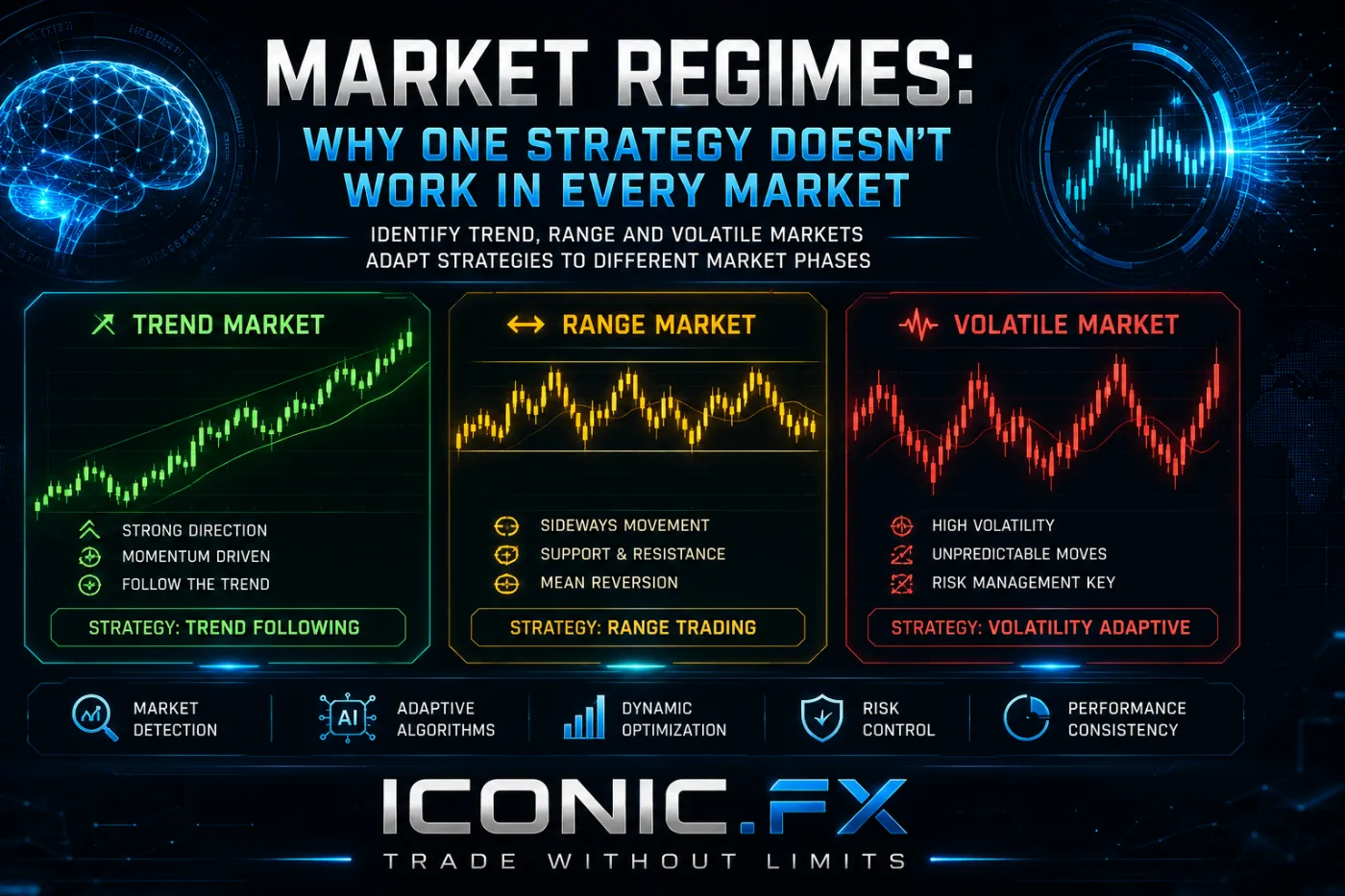
Every trader eventually lives through the same painful sequence. A strategy performs beautifully for weeks, sometimes months. Confidence builds. Position sizes grow. Then, without any obvious warning, the exact same strategy starts bleeding, trade after trade, as if it forgot everything it once knew. Most traders blame themselves. They tweak a parameter, second guess their entries, or abandon a genuinely sound approach entirely. Almost none of them ask the one question that actually explains what happened. Did the market itself change character beneath the strategy.
This is the concept of market regime, and understanding it properly is one of the highest leverage skills available to any trader, whether discretionary or automated. A strategy is never good or bad in isolation. It is suited or unsuited to the specific regime currently in play, and the traders who survive long term are the ones who learn to recognize which regime they are in and adapt accordingly, rather than forcing one tool onto every condition the market throws at them.
A market regime describes the underlying statistical character of price behavior over a given period, independent of direction. Three broad regimes dominate almost every tradeable instrument, and each one rewards a fundamentally different approach while punishing the others.
A genuinely trending market is the natural habitat of breakout and momentum based strategies. When price commits to a direction and continues, systems built around structural breakout logic, entering as price clears a meaningful level rather than fading it, capture the majority of the move rather than fighting it. This is precisely the design philosophy behind ICONIC BTC AI+ and ICONIC GOLD AI+, both built around daily and previous day high and low breakout logic.
Critically, neither system assumes every moment qualifies as trending simply because a level was touched. Both compute a trend linearity measurement, an R squared statistic over recent bars of the higher timeframe, quantifying how clean and orderly the prevailing trend genuinely is before a breakout is treated as tradeable. A high reading confirms a market moving with real conviction. A low reading signals the kind of directionless churn that breaks breakout systems, and the filter withholds action accordingly rather than trading blindly on every level touch.
A ranging market is the single most common reason a previously profitable trend following or breakout system begins losing money. Every touch of a boundary looks like a potential breakout, and the majority of those touches fail, reversing back into the range and stopping out a trend based entry repeatedly. This is not the system malfunctioning. It is the system doing exactly what it was designed to do, in a regime that structurally punishes that design.
This is precisely why the most sophisticated systems build regime awareness directly into their entry logic rather than trading blindly regardless of conditions. ICONIC KYBERNETIC AI+ applies a hybrid regime filter using a trend strength reading on the higher timeframe, with a fixed prior blocking new pending orders when the market is structurally ranging. What makes this filter genuinely advanced is that it does not stop at a fixed rule. Every closed trade updates a running reward estimate for the specific trend strength bucket it was placed in, and once a bucket has accumulated enough evidence, its learned verdict can override the original assumption in either direction, reopening a bucket once wrongly assumed too weak, or closing one once wrongly assumed favorable, based on what has actually happened rather than a static guess made once and never revisited.
Choppy, erratic conditions are the most dangerous regime of all, precisely because they can masquerade as either a trend or a range before violently reversing either assumption. A trader who mistakes volatile chop for a genuine trend enters repeatedly into false breakouts. A trader who mistakes it for a stable range gets caught by the eventual violent move that finally breaks free. Both mistakes are common, and both are expensive.
Handling this regime correctly requires two things working together, volatility adaptive risk sizing and the ability to detect compression before it resolves. ICONIC BTC AI+ and ICONIC GOLD AI+ scale their stop distances dynamically based on ATR rather than a fixed point value, so protection genuinely reflects current volatility instead of a number calibrated for conditions that may no longer exist. For traders who want to identify volatility compression before it resolves into a genuine move, ICONIC HULLX AI incorporates a dedicated volatility band squeeze engine, specifically designed to flag the moments a market is coiling tightly before an expansion, one of the clearest early warnings that a volatile regime shift may be approaching.
Regime identification does not require guesswork if you use the right tools consistently. A small set of measurements, applied honestly, tells you which regime is currently in play far more reliably than a gut feeling about how the chart looks.
The deepest reason a previously profitable strategy suddenly stops working is that most strategies are calibrated, whether explicitly or implicitly, to the regime that was dominant when they were built or last tuned. A rigid rule set has no internal mechanism to notice that the underlying regime has shifted, and continues executing its original logic with unthinking consistency into conditions it was never designed for. This is precisely why genuinely adaptive architecture matters so much more than any single entry rule.
Systems built on differentiable plasticity, such as the neural cores inside ICONIC BTC AI+ and ICONIC GOLD AI+, continuously rewire the strength of their own internal connections in response to live feedback, a structural mechanism for adapting to regime change rather than a fixed calibration hoping the market cooperates. The regime bucket learning inside ICONIC KYBERNETIC AI+ takes this further still, explicitly tracking which specific trend conditions have actually proven profitable in live trading and updating its own assumptions accordingly, rather than trusting a single historical calibration indefinitely. ICONIC NEUROCORE AI+ extends this same principle across two coordinated markets under one governing risk authority.
The most expensive mistake in this entire discussion is not choosing the wrong strategy for a given regime. It is refusing to acknowledge that the regime has changed at all, and continuing to force a trend following approach onto a market that has quietly transitioned into a range, or continuing to fade boundaries in a market that has genuinely broken into a persistent trend. Emotional attachment to a strategy that once worked beautifully is one of the most common reasons traders ride a regime mismatch far longer than the evidence justifies, precisely because admitting the market has changed feels like admitting the strategy, or the trader, has failed.
A genuinely disciplined system removes this emotional trap entirely by building regime detection directly into its own decision process, rather than relying on a human to notice the shift and intervene manually, often too late and too emotionally to act cleanly.
What is a market regime in trading?
A market regime describes the underlying statistical character of price behavior over a period, most commonly categorized as trending, ranging, or volatile, independent of overall direction.
Why does a profitable strategy suddenly stop working?
Almost always because the market’s underlying regime has shifted while the strategy’s logic, calibrated for a previous regime, continues executing unchanged, exposing it to conditions it was never designed to handle.
How can I tell which market regime I am currently in?
Trend strength readings on a higher timeframe, statistical trend linearity measurements, volatility comparisons through average true range, and agreement across multiple timeframes together provide a far more reliable read than visual impression alone.
Can an automated trading system adapt to changing market regimes?
Yes, if it is built with genuine regime awareness. Mechanisms such as trend linearity filters, adaptive volatility based sizing, and online learning that tracks which conditions have actually proven profitable allow a system to adjust rather than apply the same fixed logic regardless of context.
What is the most dangerous market regime for retail traders?
Volatile, choppy conditions, since they can convincingly masquerade as either a trend or a range before violently reversing either assumption, damaging both trend following and mean reversion approaches alike.
Which ICONIC.FX system has the most explicit regime learning?
ICONIC KYBERNETIC AI+ tracks the actual live profitability of each trend strength bucket over time and can override its own original priors in either direction based on that evidence, with a small amount of deliberate exploration ensuring it never permanently stops questioning its own assumptions.
The strategy that stopped working was very likely never broken. The market beneath it changed character, and nothing in the approach was built to notice. This single reframe, from a story about personal failure to a story about regime mismatch, is one of the most liberating shifts a trader can make, and it points directly toward the actual solution, building or choosing systems with genuine regime awareness engineered into their core rather than hoping conditions stay favorable forever.
Explore systems built with exactly this awareness across every major regime, from the trend linearity filtering of ICONIC BTC AI+ and ICONIC GOLD AI+, through the squeeze detection of ICONIC HULLX AI and the parallel multi timeframe scanning of ICONIC TITAN AI, to the self learning regime buckets inside the flagship ICONIC KYBERNETIC AI+ and the coordinated dual market intelligence of ICONIC NEUROCORE AI+. Review the flagship’s verified live statistics, browse the full ICONIC.FX ecosystem, or mirror the systems hands free through performance aligned copytrading, where the system earns only when you profit.
Risk Disclaimer. Trading foreign exchange, cryptocurrencies, commodities and other leveraged financial instruments carries a high level of risk and may not be suitable for all investors. The high degree of leverage can work against you as well as for you. Past performance is not indicative of future results. Automated trading systems, indicators and Expert Advisors do not guarantee profits and can produce losses. Backtests and simulated results have inherent limitations and do not represent actual trading. ICONIC.FX provides software tools only and does not provide investment advice, portfolio management or financial recommendations. You are solely responsible for your own trading decisions. Seek advice from an independent licensed financial advisor if you have any doubts.
Explore the ICONIC.FX Expert Advisor lineup on MQL5, or mirror it hands-free through Vantage copytrading — no profit, no fee.