The Future of Autonomous Trading: When AI Becomes the Trader
The real path from hardcoded scripts to genuinely autonomous systems, what already runs in deployed architecture today, where large language models honestly fit, and the safety, robustness and regulation challenges that deserve equal weight.
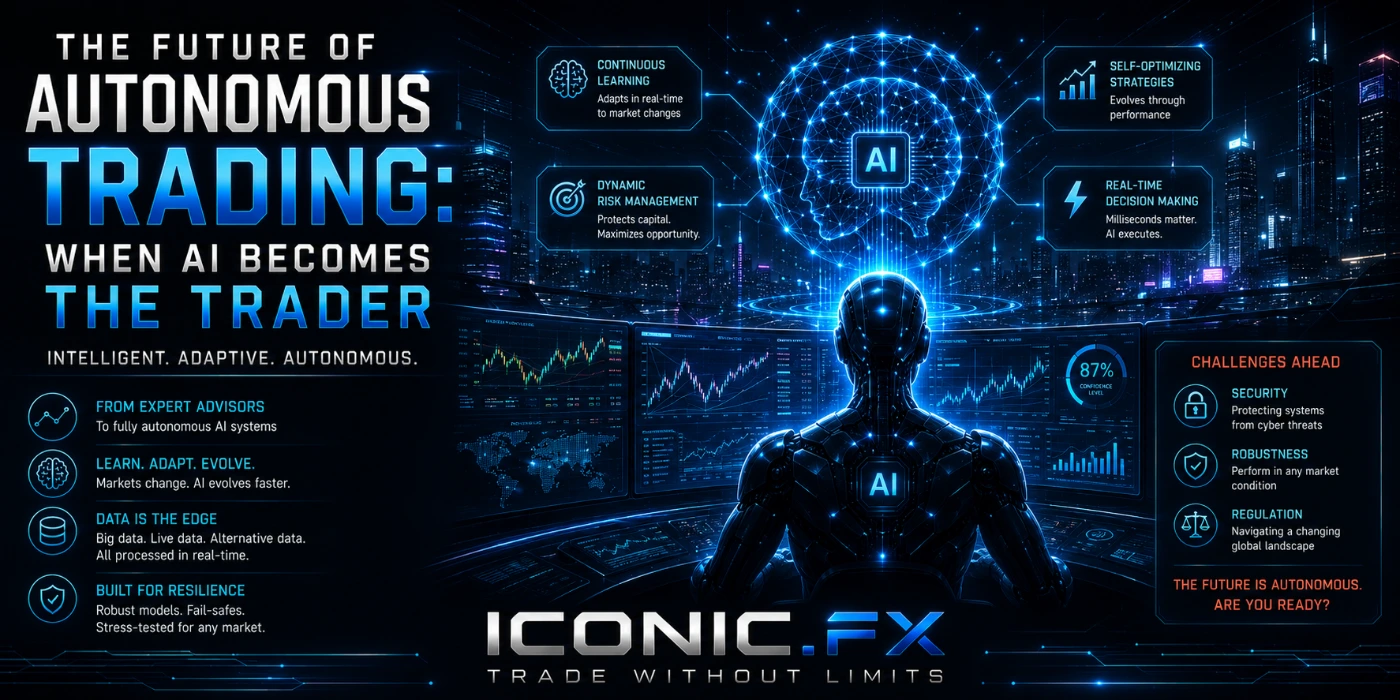
Expert Advisors were not always artificial intelligence in any meaningful sense, and understanding the real evolutionary path from simple automated scripts to genuinely autonomous systems is what actually explains where this technology is honestly heading, rather than the vague, hype driven version of that story most marketing tells. This article traces that real evolution, explains what self optimization and dynamic risk management already look like in deployed systems today, examines the genuinely emerging and still developing role of large language models and richer real time data, and treats the honest challenges around safety, robustness and regulation with the seriousness they deserve.
When people ask when AI becomes the trader, the honest answer is that, for well engineered systems, this transition has already substantially happened. It does not mean anything mystical. It means the decision loop increasingly closes without requiring a human to intervene at each individual step, while remaining strictly bounded by safety constraints a human deliberately designed into the system from the start.
The path from a simple script to a genuinely autonomous system was gradual, not a single dramatic leap. Each stage added capability while inheriting the limits of the one before it.
Hardcoded Rulebook
The earliest Expert Advisors were, in essence, automated versions of a discretionary trader’s fixed rulebook, hardcoded conditional logic (if a moving average crosses a certain level, then buy), with zero learning and zero adaptation of any kind.
Multi-Indicator Filters
The next stage layered in multiple indicators and basic statistical filters, more inputs feeding the same fundamentally deterministic decision structure.
Machine-Learning Enhanced
Trained models generated a prediction, but frequently still wrapped it in a largely static, hand coded decision and risk layer, a genuine improvement that inherited a structural weakness: optimizing prediction accuracy does not automatically optimize actual trading outcomes.
Coordinated Autonomy NOW
The current frontier: genuine adaptive decision making, continuous online learning, and hard, code enforced risk boundaries operating together as one coordinated architecture.
When people ask when AI becomes the trader, the honest answer is that, for well engineered systems, this transition has already substantially happened. The decision loop increasingly closes without requiring a human to intervene at each individual step, while remaining strictly bounded by safety constraints deliberately designed into the system from the start.
Before speculating about the future, it is worth grounding the discussion in what already exists in production systems today, because much of what gets described as futuristic is, in well engineered architecture, already running.
These are not speculative future capabilities. They are deployed architecture inside systems such as ICONIC KYBERNETIC AI+ right now, alongside hard, structurally enforced risk boundaries, a code level margin floor and a tiered portfolio drawdown framework, that operate as unbreakable law rather than a configurable preference. Understanding this matters because it sets an honest baseline before the genuinely more speculative sections that follow.
This is territory worth discussing with real intellectual honesty rather than either dismissing it or overselling it. Large language models offer a capability structurally different from the numeric feature based models covered throughout this series, the ability to synthesize genuinely qualitative information at scale, the tone of central bank communication, shifting geopolitical narrative, cross referencing a wide range of textual sources simultaneously in a way no purely numeric feature pipeline can replicate.
The honest limitations deserve equal attention. Language models are genuinely prone to generating plausible sounding but ungrounded output when not carefully constrained by verified, real time retrieval mechanisms, a serious concern in a domain where an ungrounded conclusion has direct financial consequences. Rigorously backtesting a qualitative, language derived signal is also a harder engineering problem than backtesting numeric price features, since reconstructing what a language model would honestly have concluded at a specific historical moment, without contaminating that reconstruction with hindsight, is a nontrivial and still actively developing discipline. The most plausible near term role is as a complementary qualitative layer feeding into the same causal, regime aware quantitative framework covered throughout this series, not a wholesale replacement for rigorously validated numeric models, at least not yet, and any product claiming otherwise today deserves informed skepticism.
The concept of state representation, a system’s internal understanding of current market conditions, is a natural candidate for genuine expansion. Beyond price, volume and volatility, richer real time data streams, deeper cross asset and cross market context, and alternative data sources processed responsibly represent a plausible direction for extending what a system’s internal representation of the market actually contains. This is an extension of principles already covered rather than a break from them, the same underlying philosophy of building a genuine, multivariate understanding of conditions rather than relying on a single fixed calculation, simply applied to a richer and more diverse set of inputs than currently common in retail systems.
A genuinely thorough treatment of this topic requires taking the real risks as seriously as the real capabilities, and this is precisely the section most future focused marketing quietly skips.
Adversarial Robustness
As automated participants become more prevalent, sophisticated market participants can potentially anticipate and exploit widely known algorithmic behaviors. Patterns predictable systems reliably trigger on become targets in their own right, so genuine robustness requires architecture that avoids overly predictable behavior, not merely raw predictive accuracy in isolation.
Systemic and Correlated Risk
When a large number of participants run similar categories of automated strategy, correlated reactions to the same underlying trigger can amplify a market move rather than dampen it, a systemic dynamic no single system’s internal design can fully solve on its own, since it emerges from the aggregate behavior of many participants rather than any individual implementation.
Evolving, Incomplete Regulation
Regulatory attention on algorithmic and AI driven trading continues to develop globally, and plausible future directions include stronger disclosure expectations and, quite possibly, formal explainability requirements. Retail AI trading currently operates with meaningfully less structured oversight than institutional algorithmic trading, which is part of what makes it accessible, but it also places a heavier share of genuine due diligence responsibility on the individual trader.
These honest challenges do not argue against autonomous systems. They argue for exactly the standard this entire series has consistently returned to, hard, code level risk enforcement that does not depend on the sophistication of the intelligence layer above it. As systems become more autonomous, this discipline becomes more important, not less, precisely because the honest risks described above, adversarial exploitation, correlated systemic behavior, an incomplete regulatory backstop, all point toward the same conclusion, intelligence alone was never the safeguard.
ICONIC KYBERNETIC AI+ reflects this directly, its Physics Informed margin axiom and three tier drawdown framework function as unbreakable law regardless of how sophisticated its decision making becomes, and ICONIC BTC AI+ pairs its continuously adaptive neural architecture with exactly the same non negotiable standard, a hard stop loss on every position and a categorical rejection of grid and martingale, that this entire series has argued should never become optional simply because the intelligence around it grows more advanced.
Has AI already become the trader, or is this still a future development?
For well engineered systems, this transition has substantially already happened. Adaptive decision making, continuous online learning and code enforced risk boundaries already operate together in deployed systems, rather than existing only as future speculation.
How did Expert Advisors evolve into autonomous AI?
In stages: hardcoded rulebooks with zero adaptation, then multi indicator statistical filters, then machine learning enhanced prediction wrapped in static risk logic, and finally coordinated architectures combining adaptive decision making, online learning and hard code enforced risk boundaries.
What role could large language models play in future trading systems?
A plausible complementary role synthesizing qualitative information, central bank communication tone and geopolitical narrative, feeding into existing quantitative frameworks, though genuine limitations around grounding and rigorous backtesting remain unresolved engineering challenges rather than solved problems today.
What are the biggest safety risks as trading becomes more autonomous?
Adversarial exploitation of predictable automated behavior, systemic risk from many participants reacting correlatedly to the same trigger, and an evolving, currently incomplete regulatory landscape that places significant due diligence responsibility on the individual trader.
Does more autonomy mean less need for risk management?
The opposite. As decision making becomes more autonomous, hard, structurally enforced risk boundaries become more important, not less, since intelligence alone has never been a substitute for enforced discipline.
Which ICONIC.FX systems are genuinely autonomous today?
ICONIC KYBERNETIC AI+ combines self calibrating confidence, online learning and regime tracking with a code level margin floor and a three tier drawdown framework; ICONIC BTC AI+ pairs a continuously adaptive neural architecture with a hard stop loss on every position and a categorical rejection of grid and martingale.
The future of autonomous trading is not a single dramatic leap waiting to happen. It is a continuation of a real evolution already well underway, adaptive decision making and continuous learning already deployed today, genuinely promising but still maturing technologies such as language model integration on the horizon, and honest challenges around robustness and regulation that deserve exactly as much attention as the capabilities themselves.
Explore systems built on exactly this principle, adaptive intelligence bounded by non negotiable, code enforced discipline, including ICONIC BTC AI+ and the flagship ICONIC KYBERNETIC AI+. Review the flagship’s verified live statistics, browse the full ICONIC.FX ecosystem, or mirror the systems hands free through performance aligned copytrading, where the system earns only when you profit.
Risk Disclaimer. Trading foreign exchange, cryptocurrencies, commodities and other leveraged financial instruments carries a high level of risk and may not be suitable for all investors. The high degree of leverage can work against you as well as for you. Past performance is not indicative of future results. Automated trading systems, indicators and Expert Advisors do not guarantee profits and can produce losses. Backtests and simulated results have inherent limitations and do not represent actual trading. ICONIC.FX provides software tools only and does not provide investment advice, portfolio management or financial recommendations. You are solely responsible for your own trading decisions. Seek advice from an independent licensed financial advisor if you have any doubts.
Explore the ICONIC.FX Expert Advisor lineup on MQL5, or mirror it hands-free through Vantage copytrading — no profit, no fee.